
Experiencing Revision (and Writing) in the Classroom
In a writing class, what could be more important than writing?

The Important Work is a space for instructors (and occasionally students) at all levels—high school, college, and beyond—to share reflections about teaching writing in the era of generative AI.
This week’s post is by Devin Donovan, who teaches first-year writing at The University of Virginia.
If you’re interested in sharing a reflection for The Important Work, you can find information here.—Jane Rosenzweig
This past semester I taught a first-year college writing course where students and I completed all the writing in the classroom. We wrote in blue books by hand to cultivate an environment free from digital distraction.
One of the elements I was most excited about—perhaps because I could not see it very clearly in the planning stages—was how students and I would revise our work. I knew I was excited to revise on paper. The last time I asked for printed out hard copies of drafts was 2018. Since then I have observed a gradual slide in the rigor with which students really reworked their writing in revision. This makes sense when we think about how reading practices differ between the screen and the page. If we also read our own work more quickly and less deeply when it’s on a screen, it’s no wonder that our revisions might stay in the shallow end.
As I thought about what might be possible in terms of rigorously reworking a handwritten draft, I remembered what my mother had told me when we got our first computer in the house (I was in fifth grade). She said the word processor’s “cut and paste” function was named after an actual physical process that she employed in college. She would cut (with scissors) any part of her handwritten essay she wanted to move and then paste it (with glue) where she wanted it to go. Even as a child—mesmerized by the digital magic of making text disappear and then reappear on the screen—I was fascinated by the undeniable physicality of the process she described. Separating a section of paper by tool and by hand, moving a sentence—with intention, curiosity—to see how different it sounded in a new location. This became my plan for how to revise our blue book drafts in class. Old-timey, as my seven-year-old would say.
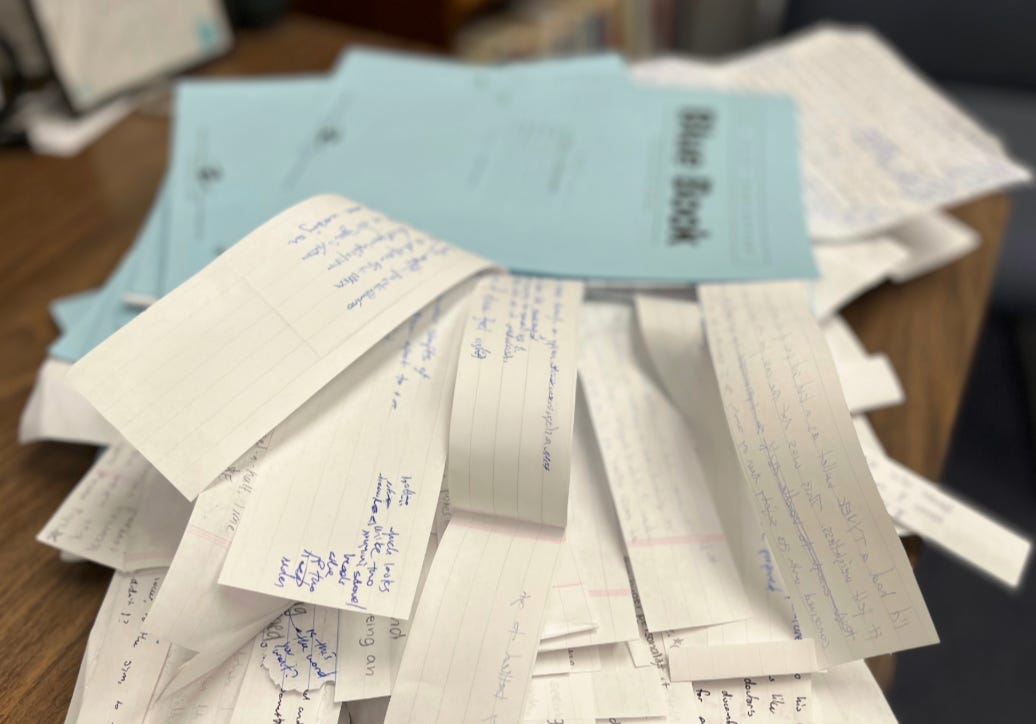
The essay prompts we worked with varied. We drafted five pieces throughout the semester and students chose three to revise. Each prompt asked students to use some combination of course texts, personal experience, and analysis to think on the page—a hallmark of our writing program’s emphasis on critical inquiry.
On the day(s) we revised our chosen drafts, I brought in eight pairs of scissors, ten rolls of scotch tape, eight glue sticks, a box of colorful markers, and many pre-cut slips of lined paper. I showed my students how I was planning to paste strips of new language in the margins of my own blue book and encouraged them to develop a system that worked for them. Our goal for the day, I said, was to make our drafts look like those inflatable tube dancers outside car dealerships.
I asked students to “play and explore” and also “rethink and extend” their ideas in response to feedback they had received from me and their peers. I also provided a series of guidelines to encourage thorough reworking:
Strike through at least three sentences.
Generate two-hundred-fifty words of new prose.
Move something from one spot in the draft to another.
In practice, these requirements actually became a bare minimum. Once they let go of the idea of revising (or editing) as a way to protect what they already had, most students saw how many sentences they didn’t need (more than three) and added closer to five-hundred words of prose. Students who liked their original line of thinking saw how time and renewed attention opened avenues for greater depth and complexity in their ideas. Students who felt their ideas were all over the place were able to go back and rewrite significant portions of their paper and or build the bridges needed to better connect and develop their thought process. Wherever their drafts were, the activity asked every student to take their ideas into new territory.
I can still hear the sounds of those class sessions. The pages of blue books crinkling as we flipped back and forth to evaluate the trajectory of our ideas. The sound of scotch tape being cut across plastic teeth as new language found a home. Whispers from students asking one another to pass the scissors. The often invisible process of revision became not only visible, but audible, and physical.
Dinty Moore invites us to consider revision a kind of remodeling, a practice where we take all the furniture out of a room to make conscious decisions about what belongs and where. The scissors, the tape, the glue allowed us to play physically with the metaphor. Each slip of paper—whether from the draft or new prose—became a little piece of furniture students held in their hands as they decided what to do with it.
Ever since hearing my professor in graduate school say he was taking his students to an Aikido class to move physically through rhetorical stances, I have tried to help my students take an embodied stance toward their learning. We play with LEGO to practice the childlike openness that Anne Lamott asks us to draft with. We visit our university’s Makerspace to look at composition as an act of creation. We investigate simple machines to compare them to the mechanics of a sentence, a paragraph, or a piece of writing. I enjoy the way these activities, as metaphors, can help translate abstract course concepts into physical lessons. But what this blue book, handwriting, cut-and-paste course really helped me remember is that writing is itself an embodied practice. As one of my students wrote in a reflection on the course, “I had time to physically work through my writing and thoughts with my peers in a process that was more hands on.”
Writing is also (or can be) experiential learning. Unlike, say, the way we might navigate an Economics course (at least how it was taught when I took one), we are not simply learning about writing—we are practicing writing.
While I believe the physicality of our class amplified student connection to the experience, the specifics of my revision activity strike me as less important than its underlying motivation—to help students focus on a challenging process in community with other learners. Writing is an embodied practice whether we’re composing by hand or typing on a computer. It’s also true that both these modes of writing can be done superficially, especially when competing with everything else that claws at a student’s attention. It seems to me, then, that the key to helping many students really experience writing as a process of patience, careful attention, and imagination is to create the dedicated time and space needed for them to invest themselves in the work. If the difficult process of writing feels to students like it’s costing them something they can’t afford, it’s not surprising that they’ll look for ways around it. And as my colleagues in our Center for Teaching Excellence like to say—if it’s important, make class time for it. In a writing class, what could be more important than writing?
 | A guest post by
|