
Shaping Sentences, Shaping Thought
My goal is not to make them write faster, like a machine, but slower, like a person

The Important Work is a space for writing instructors at all levels—high school, college, and beyond—to share reflections about teaching writing in the era of generative AI. We hope to spark conversations and share ideas about the challenges ahead, both through regular posts and through comments on these posts. If you have comments, questions, or just want to start a conversation about this week’s post, please do so in the comments at the end of the post.
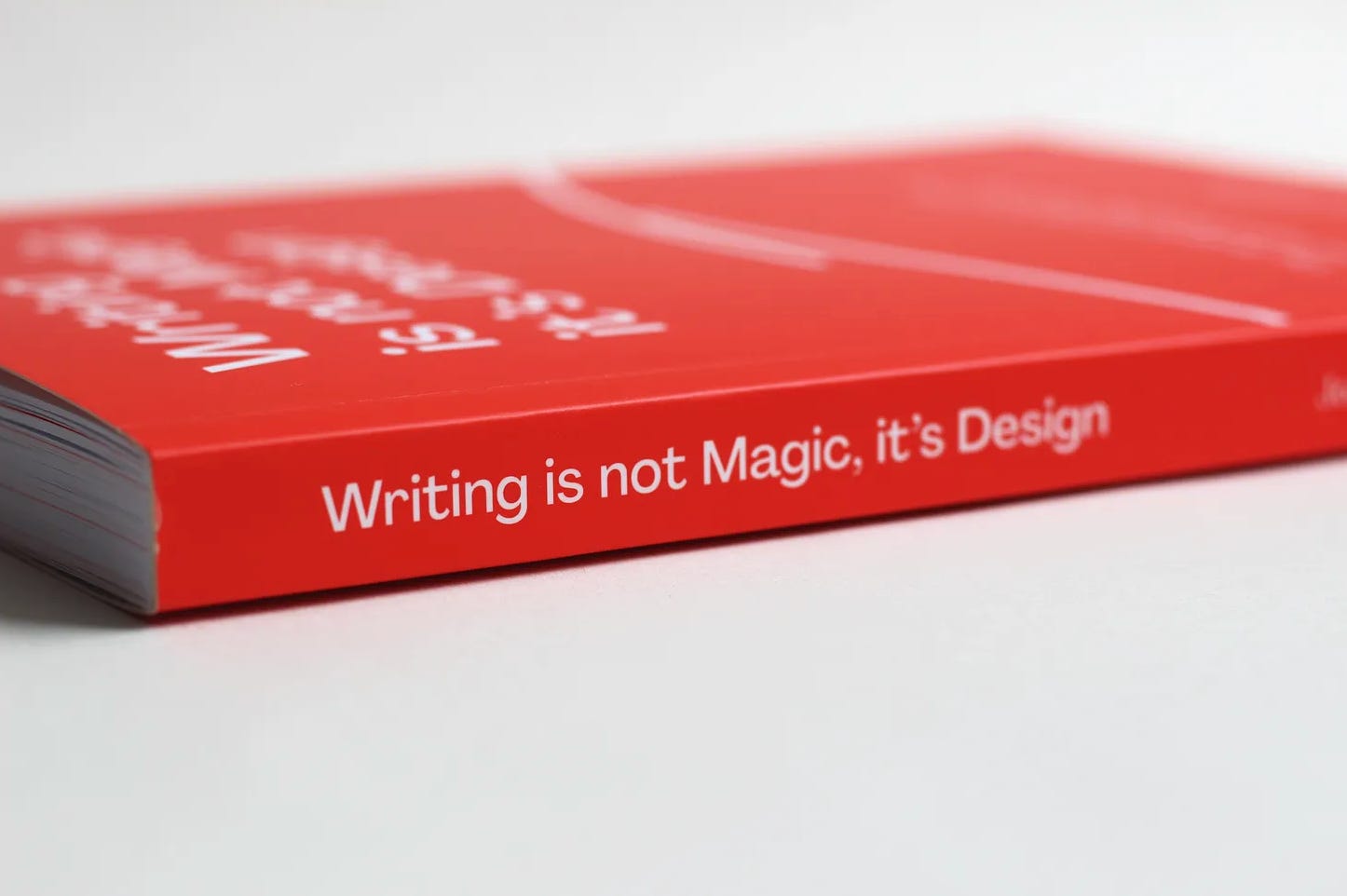
This week’s post is by João Batalheiro Ferreria. João is an assistant professor and research coordinator at IADE–Faculty of Design, Technology and Communication, Universidade Europeia, where he teaches Visual Design, Design Methodology, and writing seminars. João’s research focuses on design education; in particular, he examines how students make sense of the design process through design conversations in the design studio. He is the author of Writing is Not Magic, It’s Design and the Designer’s Block newsletter You can find him on LinkedIn.
If you’re interested in sharing a reflection for The Important Work, you can find all the information here. Your reflection does not have to be about using AI in the classroom—we are interested in any way that you’re thinking about the important work these days. If you’ve redesigned assignments to avoid using AI, if you have strong feelings about when and how AI should or should not be used in the classroom, if you do something that you think works very well without AI, we want to hear about that too. —Jane Rosenzweig
I teach graduate design students how to write. It’s not easy. Designers spend years drawing, sketching ideas, and building models. They think visually, not verbally. Then, in graduate school, we ask them to advance human knowledge using words. No pressure. Of course, advancing human knowledge using words is difficult for anyone. For those without practice, it feels impossible.
Enter ChatGPT and the like. Overnight, students have an instant fix. But instant fixes seldom arrive without cost. The cost, in this case, is their thinking. Many students used to struggle with blank page anxiety—the feeling of not even knowing where to begin writing. I seldom see that anymore. I suspect they have replaced blank page anxiety with filled page (false) security.
The temptation is understandable. Students believe their dissertation should be a masterpiece, and they freeze. But a dissertation is just a document demonstrating their ability to conduct independent research. The goal of a graduate degree is not the dissertation but to go through the process of writing one.
Independent research requires deep reading and critical thinking. Students must identify gaps in knowledge, frame a research question, and set up rigorous studies. Eventually, three or four years down the line, they write a well-reasoned, logically sound, impeccably referenced, and original piece of writing that makes a small contribution to scholarship.
Or they can bypass all that using AI.
Why is that a problem? AI tools mimic human understanding, outsourcing our thinking. When we outsource thinking, the mind dulls. And no, I don’t think you can use AI just a little, any more than you can slip on the ring of Sauron and escape its pull.
Some argue that AI can help with small parts of writing, like brainstorming or revising. This point of view overestimates the willpower of a human being. Once a tool offers an easier path, the harder one grows harder still. AI assistance may start harmlessly, but the line between aid and crutch is thin. Why struggle to articulate an idea when a machine can phrase it for you? Why wrestle with a difficult concept when AI offers an instant explanation? What starts as a convenience quietly becomes dependence. And over time, reliance on AI takes over.
And for what?
When using AI, you’re sacrificing the writing process to obtain mediocre results. The ends don’t even justify the means. AI-generated text is neither good nor bad, just soulless and average. Is that what the world needs? More soulless and average writing?
The writing process matters because writing is an act of intellectual transformation, not just a tool of communication. Writing expands us. It pushes the frontiers of our minds. Thinking and writing are entwined at every level, from note-taking to revising.
And yet, even before AI, most writing lacked human spark. Too often, we meet sentences like we strive to leverage synergies to drive innovation. Such sentences don’t leap off the page, they sink into it. They weren’t written by a person but parroted by convention. Language was robotic long before robots started writing; so, what can we do?
I now center my teaching on the study of sentences because a sentence gives concrete shape to the fluid nature of our thoughts. Sentences shape thought. When design students view writing as shaping sentences, they relax, because design is about shaping things. If designers can shape things, they can shape sentences too. I used to dedicate much effort to paragraphs and chapter structure, but a focus on sentences helps instill a sense of the craft of writing. With sentences, I can show them how writing and thinking merge, how their sentences gradually build their voice and shape their arguments.
They can learn writing by studying how good sentences work. And design has the perfect tool: reverse engineering. To reverse-engineer a sentence is to dismantle it, studying its structure and elements.
Take Churchill’s line: “Never in the field of human conflict was so much owed by so many to so few.” We can break it apart to uncover the patterns at work (rhythmic repetition at the beginning of clauses, or anaphora, to name one). A pattern is a design we can repeat. Once students recognize these underlying structures, they can apply them to craft good sentences.
That’s when my students struggle. When it’s time to put words down, their first draft inevitably defaults to academese, which is the monotone their ears pick up from reading academic papers. At that point, my job is to reverse engineer their sentences. But students become defensive. And I can only make progress during one-on-one tutorials, with the rest of the class gone.
I sit beside them, and together we zoom in on a sentence. The goal is to unearth the thought buried beneath the lukewarm soup of academic fluff. I ask, “What were you trying to say here?” Their answer is often clearer than the muddled words on the page. “Write that,” I tell them. “Write with your own voice.”
I never accuse them of using ChatGPT. Instead, when I come across a sentence that feels artificial, I say, “This is where I stopped hearing your voice—and I missed it.” That usually gets through. Another powerful approach is showing them my messy first drafts, letting them see how I struggle to shape ideas into coherent sentences. I invite their vulnerability by being vulnerable myself.
Working at the sentence level takes time, which is fine. My goal is not to make them write faster, like a machine, but slower, like a person. AI can ‘read’ a billion recipes in a second, but it will never know the taste of a perfectly seasoned bruschetta. And a database with all of Shakespeare’s plays gets us no closer to understanding Hamlet’s despair.
I tell them: Don’t try to outpace the machines, but yield no ground. You will never be as fast as a computer. A computer will never be as slow as you. So slow down. Read, write, and wrestle with ideas. Write poorly. Make mistakes. Write seventy thousand shitty sentences. Remember, the first million words are practice. Be vulnerable; computers aren’t. And vulnerability is the path to wisdom.
I don’t know if the future will be more robotic and artificial. I hope against hope that it won’t. But education will endure if it manages to hold on to its human qualities. Teaching students to express an original thought in their unique voice is fulfilling in itself. And perhaps, now more than ever, essential.
 | A guest post by
|
Yes. Thanks for this. I'm going to save it and come back to it now and then. I especially appreciate the approach of saying I lost their voice and missed it.