
Writer Come Home
A college student and her high school teacher talk AI


The Important Work is a space for instructors (and occasionally students) at all levels—high school, college, and beyond—to share reflections about teaching writing in the era of generative AI.
This week’s post is by Aadya Gattu and Jennifer Tannous. Aadya is a Morehead-Cain scholar at UNC Chapel Hill, where she is studying Economics and Political Science. She believes that a head-on approach to AI governance is necessary, and she cares deeply about exploring that through reading and writing. You can find her on LinkedIn and Instagram @aadyagattu. Jennifer is a high school English teacher of 21 years, and she is the writing center director at her school. As vice president of the Secondary Schools Writing Center Association, her focus is to build community through the support and development of better writers. She firmly believes that every writer needs a reader who can provide compassionate conversation and modeling. You can find her @jatannous.bsky.social.
If you’re interested in sharing a reflection for The Important Work, you can find information here.—Jane Rosenzweig
Aadya
Two years ago, while a high school senior, I was one of 22 students out of 600,000 to get a perfect score on an exam that evaluated my writing skills. A few months ago, as a college sophomore, I was using ChatGPT to write a random email when I grew so frustrated with myself that I emailed my 10th grade English teacher to express my fears that AI was now making me a worse writer.
From this email blossomed a correspondence with one of the most wonderful teachers I’ve ever had, Ms. Tannous. In talking to her, I boiled down the academic conflict I was having: fear of becoming a worse writer. Perhaps it was imposter syndrome. Perhaps it was the feeling of being on top of the world as a senior, to toppling down to lowly freshman status. The underlying fear, the one I least wanted to admit, was the possibility that it was AI. Whatever the case, I wanted to come home.
Ms. Tannous
Aadya, one of our high school’s shining scholars and one of my writing center tutors, returned to me first via email. She wrote in part, “as college and life gets harder, I have naturally been turning to AI tools for my writing. I feel lost and am genuinely fearing that my writing skills are declining and that I am dependent on AI for all writing.”
Her email remained in the periphery of each lesson I taught and each interaction I had for weeks. Lost, fear, decline, dependent; these are not the words that usually come to mind when I welcome home recent graduates. Most high school teachers relish those moments when former students or graduates return to them, more poised, grown, graceful, confident, and cultivated. We embrace them anew, pleased to engage with this mature and sprouted version of the student we had in our schools and classrooms. But Aadya’s confusion, angst, and dismay was palpable. Her rawness and existential dread required an answer, but what could I offer? Her vulnerability left me feeling a little lost, too. What had gone wrong?
Aadya
As a college student, I have turned to AI because I’m too “busy.” I use AI to write my email responses because I want to delegate my time to what “actually needs my attention.” I authorize an external thinker for my busy work because I arrogantly assume certain assignments are not worth my time. This sentiment is common amongst my peers: the minimum requirements to be a high-achieving student continually rise, and if we don’t outsource certain work, it can feel impossible to get it all done.
Ultimately, I was looking for guidance in understanding what I wanted out of my relationship with AI, because I knew that demonizing the entire concept of it was causing me to feel guilty for utilizing it in both useful and detrimental contexts. I needed to find time with a mentor I trusted and build a safe space to reflect on where I have grown, where I have fallen off, and where I want to continue as a writer who is realistic about the future of writing.
Ms. Tannous and I corresponded about this dilemma together, and during that process, I had many a therapy session with her. I vented about the different levels of guilt I felt when I used AI in different contexts and how I was worried this would be fundamentally detrimental to my academic and law school aspirations.
I felt grounded when we’d talk about the familiar. When Ms. Tannous reminded me, in plain words, that I was a good writer, I felt different. When we talked about smaller ways we both incorporate writing into our day to day lives, in creative and non-creative outlets, I started to feel a bit better about where I was moving as a student. One of the biggest “breakthroughs” came through outlining the different buckets of AI use in my own life, essentially drawing my boundary lines.
Ms. Tannous
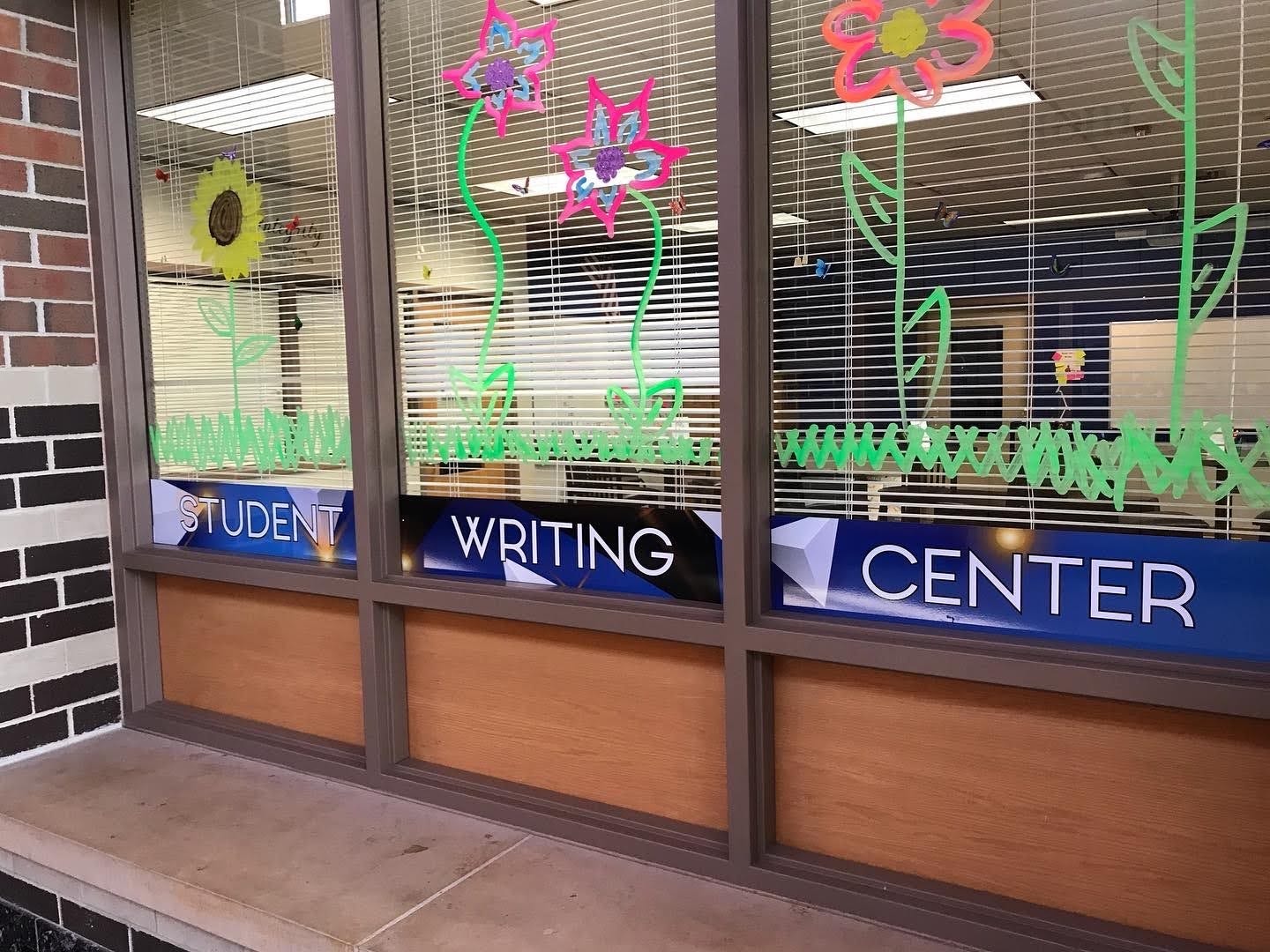
My conversation with Aadya happened back in our high school and the writing center that was such a familiar and integral part of her maturation as a learner, writer, and leader. Perhaps this familiarity could provide a partial response for students like Aadya: when you find yourself knocked off balance by AI, return to your roots: come home.
Our conversation helped me remember our role as teachers: to focus on the learner, build confidence, and create space for students to return to in times of doubt. AI cannot do this.
By home, I mean to those notions of ourselves as learners that are bred from confident interactions with critical thinking. In my conversations with Aadya, I was learning that in her (and many students’) natural moments of doubt or uncertainty at the collegiate level, they found more comfort in AI, lured into a falsehood and then ensnared and imprisoned in self-doubt. Instead of Aadya growing stronger, AI grew on what she fed it: her ideas, prompts, work ethic, engagement, and ultimately, her confidence.
We know we are learning and growing when we grapple, tackle, cope, confront, and make attempts. These attempts happen only when students feel safe enough to be vulnerable, brave enough to try, and confident enough to begin this journey. As I talked with Aadya, I realized what she was asking for was a real audience, someone to talk through this with her, and someone to remind her of her potential. Our conversation helped me remember our role as teachers: to focus on the learner, build confidence, and create space for students to return to in times of doubt. AI cannot do this.
Perhaps this is where high school teachers and college professors can form a better Venn diagram around our learners. We can make space and make time to have conversations about the purpose of writing as more than a task, an assignment, a box to check off on an LMS, but as a lifelong endeavor and social act that touches every discipline and every learner, an act that Isaac Asimov has described as simply as “thinking through my fingers.”
In this vein, I’ve learned how to respond to my students with greater curiosity, more listening, less judgment, and a great deal more encouragement.
My conversation with Aadya forced me to consider better guiding questions that can help writers talk through not just their AI use, but also their confidence awareness:
Where, when, and how do you feel grounded and supported as a writer?
How might you reclaim what you lose when you prompt AI?
Do you feel good about your writing or fulfilled as a writer and learner?
Is AI really, in the end, producing writing for you that you like?
Is AI really, in the end, saving you time? AND
Is the time you save a worthwhile payoff for what you are losing?
When is the last time you arrived at a conclusion of your own after thinking deeply?
Can you make better choices about what you use AI for and when?
In Reader Come Home, a research-based book that explores the brain’s ability to read deeply in our increasingly digitized world, Maryanne Wolf offers a jarring warning replete with cognitive psychology and literacy; while her tone and dire warning about the cognitive atrophy that may result from constant screen use chills me to this day, she also arms us with a roadmap, a hope, and a prayer for how we might seek deeper reading and engagement in our core humanity.
At times, I see our current writing instruction and AI bubble as an extension of Wolf’s warnings: the digital reality we swim in may drown us if we don’t discuss and find some life rafts that will float our writers back home. After my conversations and co-writing sessions with Aadya, the AI elephant in the room became an opportunity for my growth and hopefully the growth of my students.
It’s actually the best place to be as a teacher: a writer alongside students, trying to figure out the complexities of our modern world together, sharing our voices.
Aadya
I told Ms. Tannous about a story from Chris Bradford, the president of my scholarship foundation. At an event earlier in the fall, Chris had repeatedly asked us to “take our brains to the gym”. He talked about how his grandfather had an athlete’s build without going to the gym because his job required physical labor. For Chris’s father or himself to achieve the same build, they had to create intentional time and space to workout. In the same sense, Chris talked to us about the default level of critical thinking changing in higher education. He exhorted us to do the simple: read a lot, write a lot, and care about what you are doing to your brains.
I’ve come to realize that the time I’m “saving” by using AI is slowly eroding my ability to write quickly, to write when I don’t necessarily want to write, and to write well.
I carried that lesson with me, and compounded with the reflection Ms. Tannous challenged me with, I came to accept a few truths. I understand that the process of writing will forever look different. I understand that higher education has not come to a clear consensus on how AI should look in the university and classroom setting, and that it is up to the individual student at this time to figure out what skills they want out of their work. Personally, I’ve come to realize that the time I’m “saving” by using AI is slowly eroding my ability to write quickly, to write when I don’t necessarily want to write, and to write well.
I’m paying attention now, actively noticing the times my professors seemed to “beat” the Faustian AI bargain with their lessons, activities, and encouragement of critical thinking. I’m thinking about the dozens of in-class essays, the intentionally difficult passages from texts that predate our country, the small group discussions on topics that cause cognitive dissonance. All these experiences have grown my critical thinking, and, in turn, reaffirmed that I am not going to revert to an elementary writing level.
Home, in my learning, is a space where I can think through ideas without fear of being wrong, fear of losing points, fear of being shamed for thinking about it wrong, and most importantly, moving past points of cognitive tension to come to a deeper conclusion. The common denominator in all the times I’ve found myself doing this, even in an AI world, is a live outlet, whether it be talking out loud, writing in real time, or a combination of both. Navigating higher education during a time of AI doesn’t need to be difficult; in fact, I’m realizing, it’s the simplest lessons that matter now more than ever.
 |
|
 | A guest post by
|
A joy to read, from both perspectives, and a reminder at a meta level, I think, that this work around AI's intersection in education has to be conversational. So much value in this format—and it goes without saying, I hope, wisdom from both writers. 🙏
This was so beautiful to find in my inbox this morning! Insightful, wise, and present, from two writers I know well and deeply value. Keep shining, Aadya. You are a brilliant writer, and don't lose that part of your identity to a machine. And keep shining, Jen. You are a brilliant teacher, strategist, and writer alongside students. This interwoven thinking will be valuable to many readers and teachers I'm sure, especially as we think of our students writing into the wide world away from the high school teachers who know their voices well.